Irons vs Optics: Why Pistol Optics is the Clear Winner
Well, pistol optics are the clear winner…at least for me. Over the past four years or so I have gradually made the switch to pistol-mounted optics for all my serious handguns. This wasn't exactly a comfortable switch and it has only been “final” for about the last two years. Since I've committed, though, there is no way I would go back. The advantages far outweigh the disadvantages. Today I want to offer a few thoughts on why I think pistol optics make sense.

This article contains affiliate links. Using these links gives us a small commission but costs you nothing. Please consider using our Amazon link to support this blog.
If you prefer to listen to this post, or watch it with semi-relevant B-roll, it is also on Youtube.
The Great Irons Vs. Optics Debate
The optic debate feels like history repeating itself. When widespread optic adoption occurred on military rifles in Iraq and Afghanistan, minds were blown. The Marine Corps stuck with iron sights for rifle range qualification long after iron sighted rifles were issued to nearly anyone. People talked about the inherent fragility of optics relative to irons and the gun community had a “sky is falling” moment for about ten years. Then everyone realized the sky wasn’t falling, optics actually made shooting easier, they didn’t break or fall off every time you sneezed, and we moved back to debating 9mm vs. .45 or something of similar importance.
And now we are repeating the debate with handguns. I understand some skepticism. I had the same skepticism five years ago. But I think at this point it’s safe to say that pistol-mounted optics are here to stay. The technology has evolved and optics are tough and reliable. They widely are used by military and police agencies, and enthusiasts. They provide a lot of benefits, if one is willing to work to master them.
And yet…. there are still a lot of guys out there who don’t like optics. Just yesterday I heard a relatively prolific YouTuber call optics “tacticool” and a “fad.” If you don’t like optics, you can find a YouTuber, blogger, podcaster, or instructor to back up your position. The thing I’ve noticed though, is that no one who is recommending against optics has really mastered them. I hear a lot of people cast doubt on optics with complaints like, “I can’t find the dot half the time,” or “it’s not nearly as fast.” This actually tells you very little about optics, and a lot about the person making the statement. They haven’t gotten really good with optics, which is necessary to actually make a fair comparison.
Now, let’s get into why optics are a clear winner for me.
Optics are Easier
I was an “optic denier” for a long time. I was really good with iron sights, I came up on iron sights. I thought everyone should force themselves to love iron sights as much as I did. When I finally put an optic on a gun, I didn’t like it. The dot wasn’t in the window half the time I presented, and it was just…uncomfortable. I played around with a couple optics, then a couple years later I decided to get serious. I took the one-day optics transition class at my sheriff’s office. This gave me a bit of a foundation. About a month later I attended a five-day class with Tom Givens. Instead of taking my favorite carry pistol, I took a P365 XL with an EPS Carry on top. Nothing like jumping in the deep end.
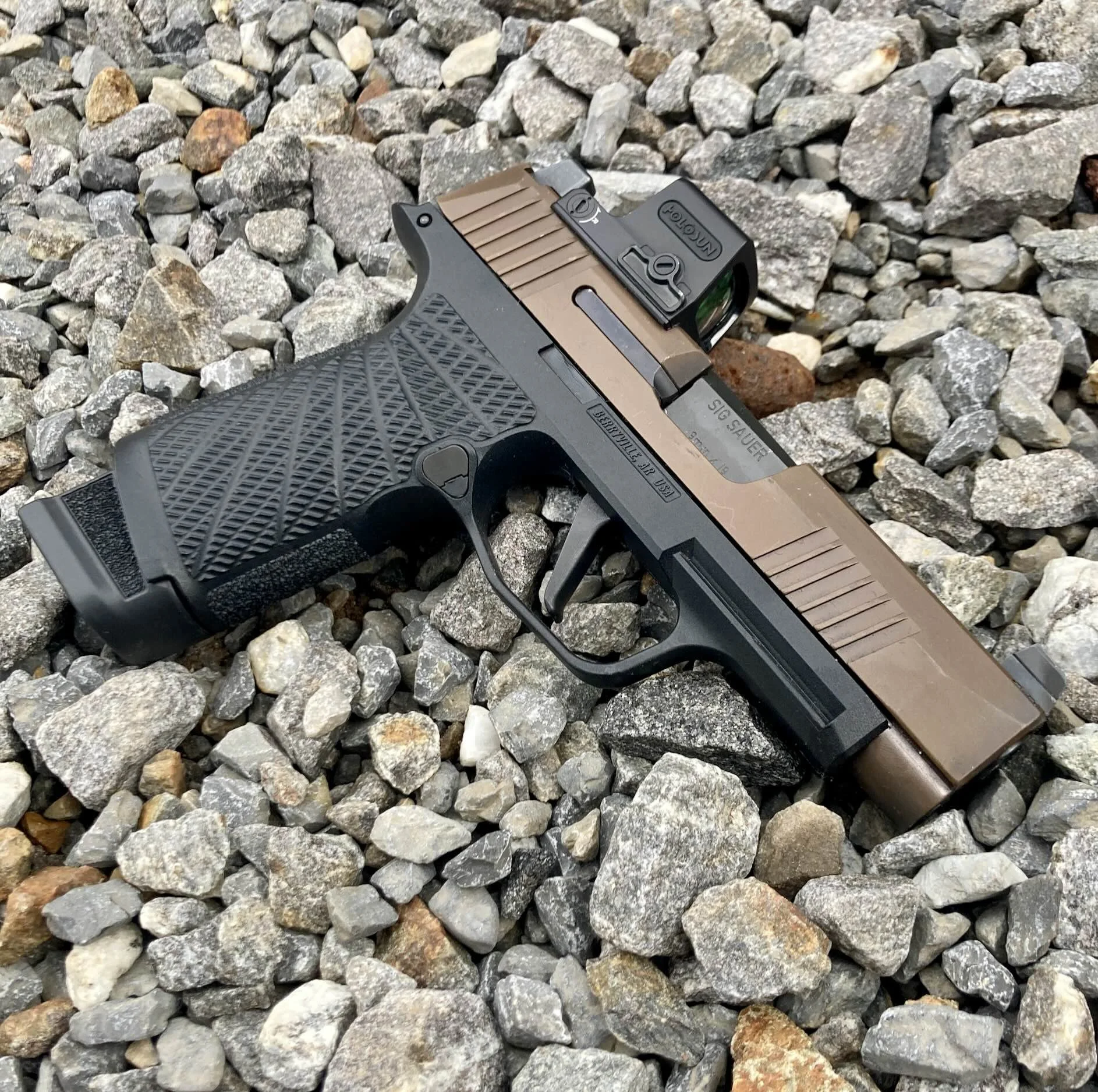
The P365 XL I that I really learned to shoot optics on.
After that I was sold on optics and started putting them on all my handguns. Occasionally when I go back to shooting an iron-sighted guns I realize just how difficult it is. You can’t look at the target, the thing you probably most want to look at. Instead you have to focus on the front sight. Not only that but you also have to focus a little bit on the rear sight. You have to line up three objects, while your target is blurry in the background… There’s just a lot going on with iron sights.
Most of that stuff is second nature to those of us who grew up shooting iron sights. Coming back to an iron sight-only gun after shooting optics for a while is jarring. Shooting with an optic is just so much easier and less mentally taxing. Shooting with irons is like shooting on “hard mode.”
Better Visual Field
The window of an optic offers a better window than iron sights. You actually get a look at a large portion of your target. The greater the distance, the more of a look at your target you get. When shooting with iron sights, the top of the slide is brought into the eye-target line. This obscures the lower portion of the target. The closer you are to the target, the more of the target that is obscured.
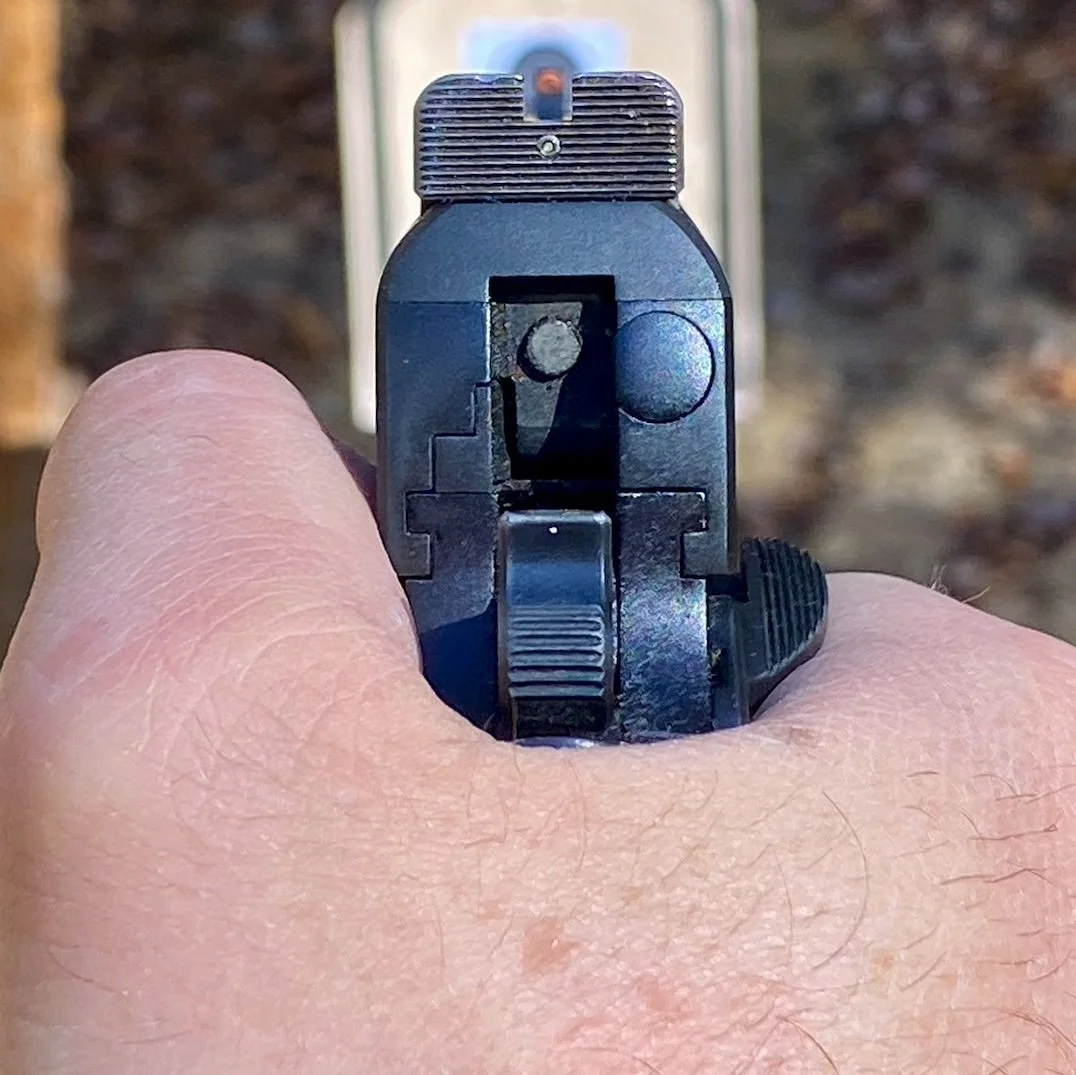
A typical view with irons necessarily obscures the lower portion of the target, and probably the hands.
If I'm in a fight, the situation will be fluid and evolving (this may be the one, constant truth of life-and-death situations), I want to be able to see as much of the bad guy as possible. If I’m obscuring the lower portion of the body, I may fail to notice the bad guy dropping his gun, or taking some other action that should alter my actions. Optics provide much better ability to keep an eye on your adversary. Compare the image above of the iron-sighted pistol to the image of an optic-equipped pistol below; you can just see a LOT more through the optic window.
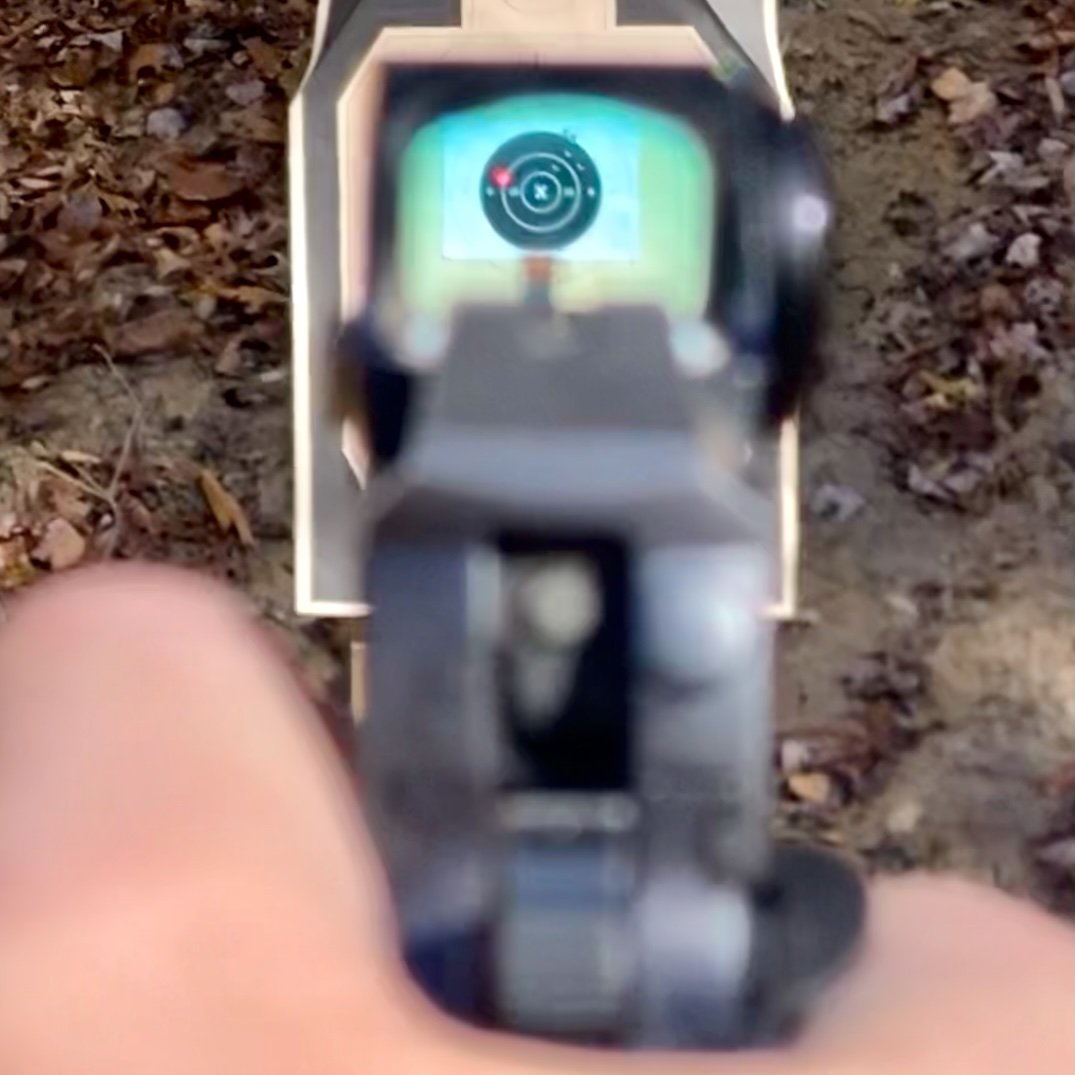
A typical view with a pistol mounted optic: much more of the target is in view. Keep in mind this is a compact optic. The view is quite a bit larger with the full-size RCR I carry on duty.
Natural Target Focus
One of the most important reasons to switch, at least in my mind, is the brain’s natural tendency to focus on the threat. When something is bearing down on us with the intent of doing serious bodily harm, our natural reaction is to give the threat our full attention. This is a well-documented phenomenon. For maximum accuracy with iron sights, we have to consciously shift focus back to the sights. This goes against the brain’s natural tendency.
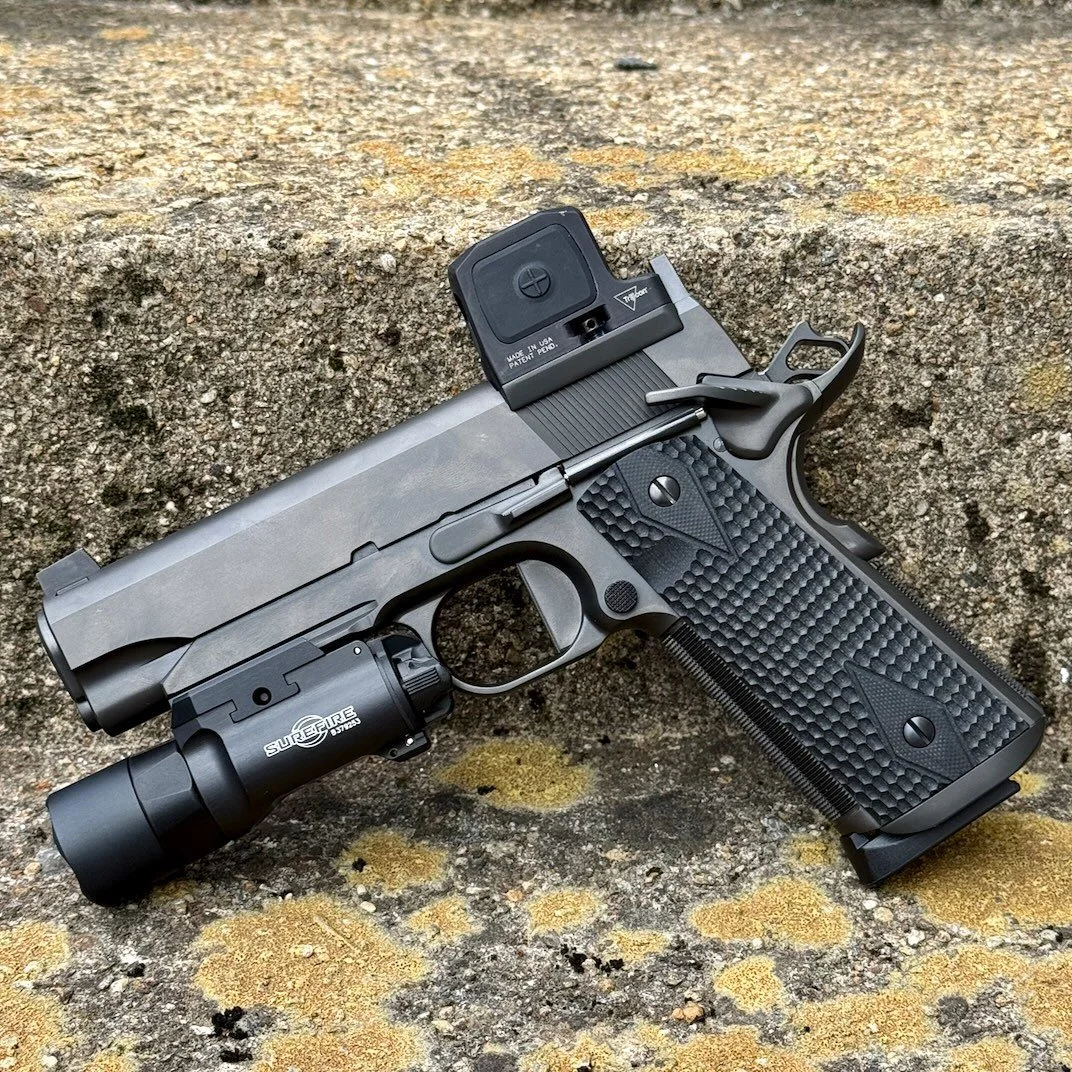
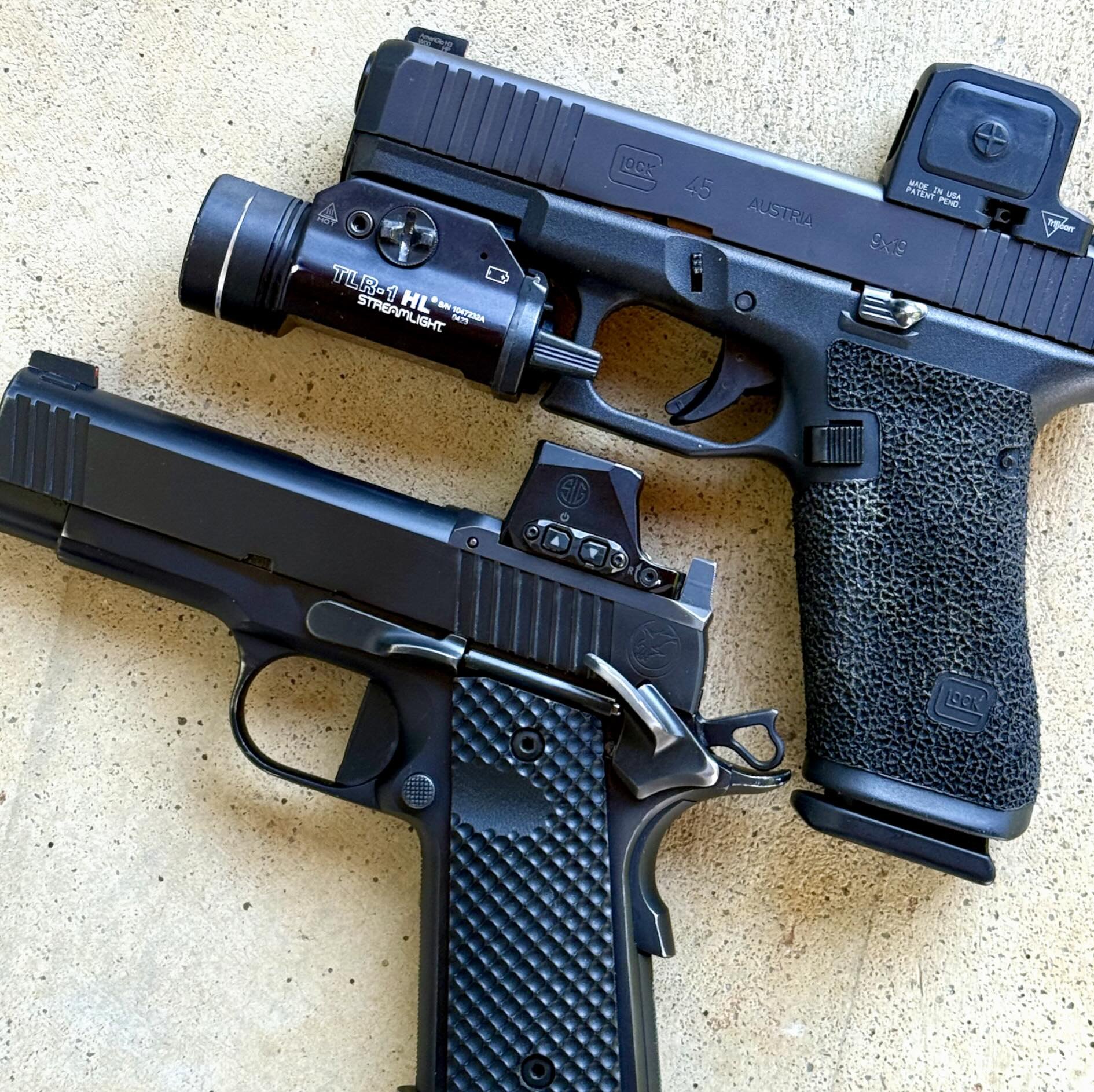
A modernized 1911 Commander with WML and optic. I would be perfectly comfortable carrying this on duty.
While I was carrying a gun with iron sights I told myself that in a fight I would be aware of this and have the presence of mind to ignore the immediate threat and focus on my sights. My experience in competition would indicate otherwise, however. Several months ago I wrote an article about the hidden benefits of competition. In it I related a story that illustrates that sometimes - despite a tremendous amount of training and some actual experience - my nerves still get the best of me and I focus on the target, with predictably poor results.
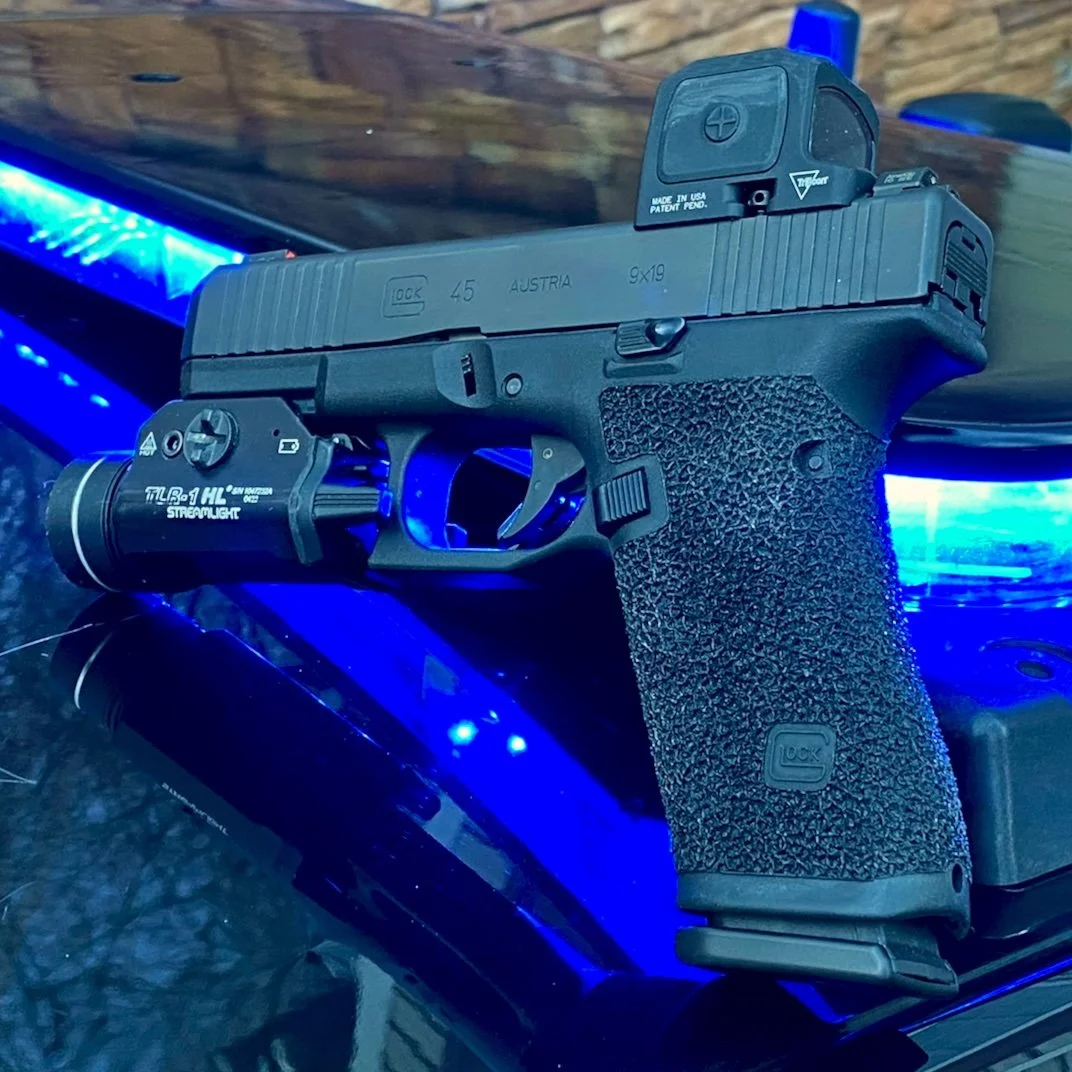
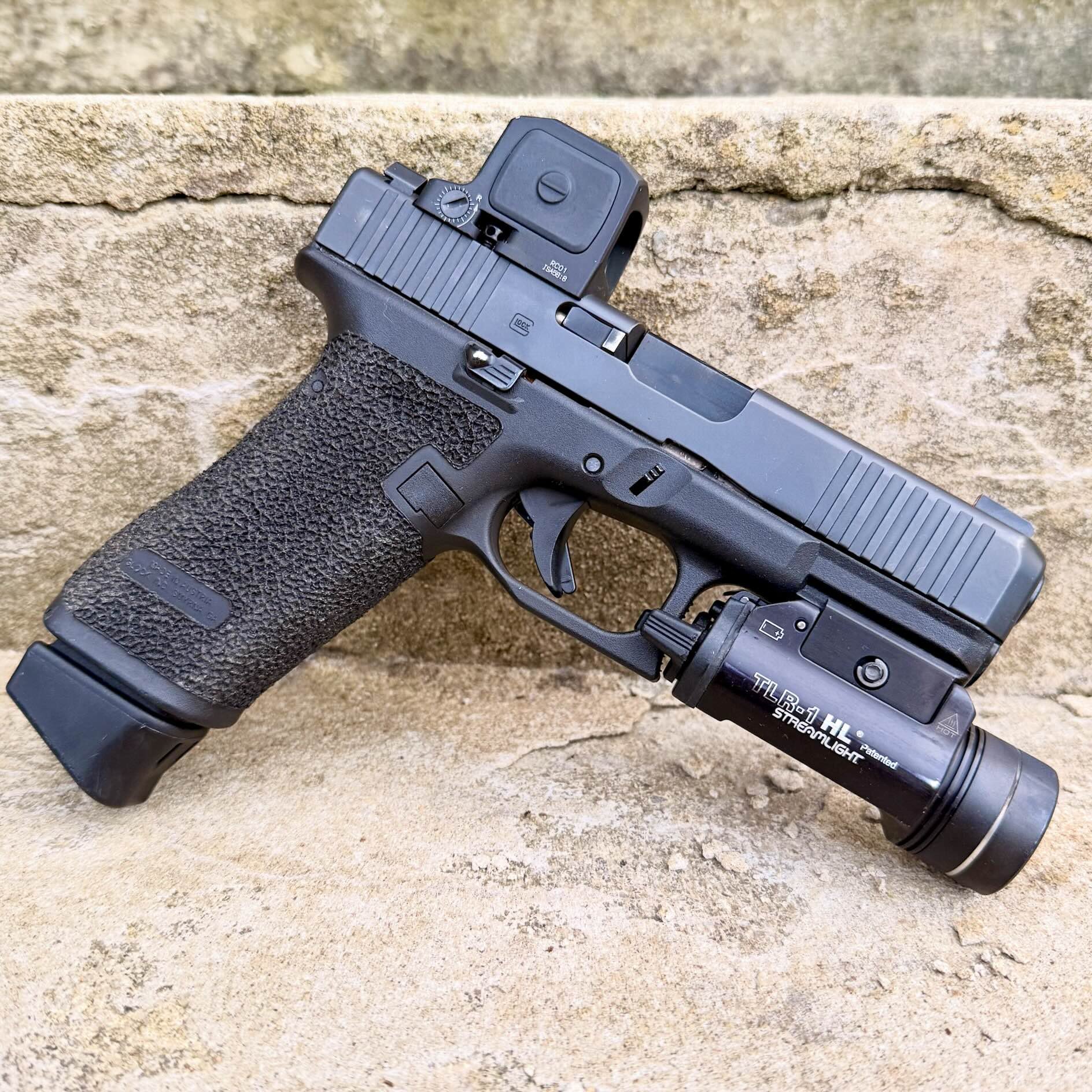
My personally-owned Glock 45/RCR duty pistol. Grip reduction by Great Lakes Custom.
Above all, I’m beginning to agree with Taylor at the Defenders and Disciples Youtube channel and podcast. Taylor says that in a rapidly evolving situation, it is dangerous to continue shooting at a person while focusing on the front sight.Think about that for a second; at any instant, your attacker could drop the weapon, turn around, or take another action to let you know that he is no longer a threat. At that point you are not justified in killing that person legally. Nor are you morally justified, at least according to my my personal set of values. Watching the target rather than switching focus from irons is the fastest way to “check in” with the bad guy to see what he’s up to.
Better Accuracy
The aiming procedure with pistol optics is a little different. Rather than having to line up three objects that seem highly irrelevant to the threat at hand (the iron sights), the eyes can focus on the target. When the dot (be it red, green, or blue) interrupts the eye-target line, the gun is lined up to make the shot - simple as that. The uncomplicated nature of an optic window, along with the much smaller dot, offers the potential for far superior accuracy.
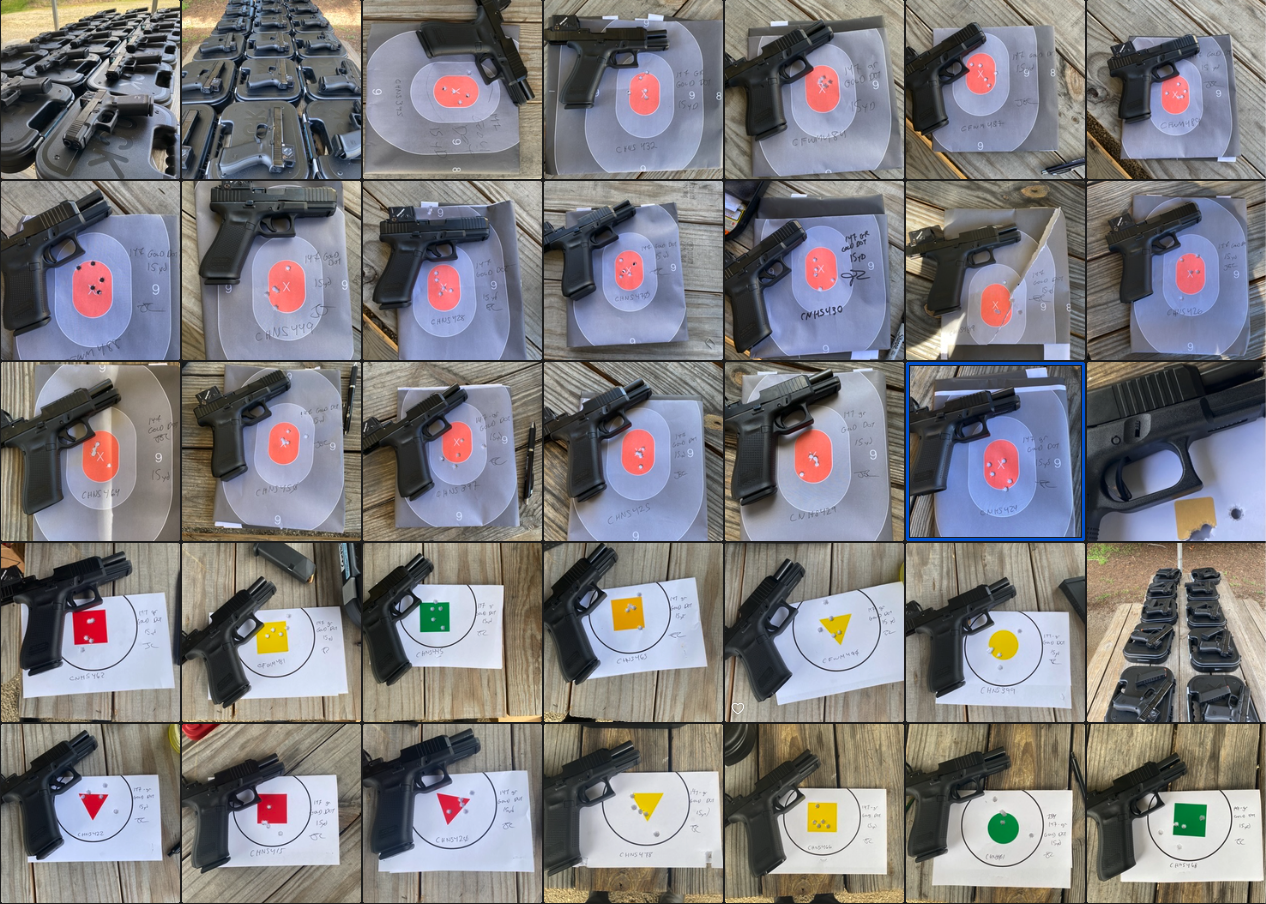
I had the opportunity to zero 100 Aimpoint COA/G45s and G19s over several days for my agency. There is no way I would have consistently turned in 100 offhand groups this small with iron-sighted pistols.
Pistol optics probably don’t provide a huge accuracy advantage at close range…but a high level of accuracy likely isn’t needed at extreme close ranges. They do provide massively better accuracy at longer ranges (say 15 and further). When shooting the Humbler drill (which is all shot at 25 yards), my front sight is almost as wide as the eight-inch circle in the B8 target. This means I have to align the front sight in the rear sight and while doing so, bisect the circle vertically, AND make sure the edges of the front sight are equal with the edges of the target. That’s a lot of stuff to keep track of.
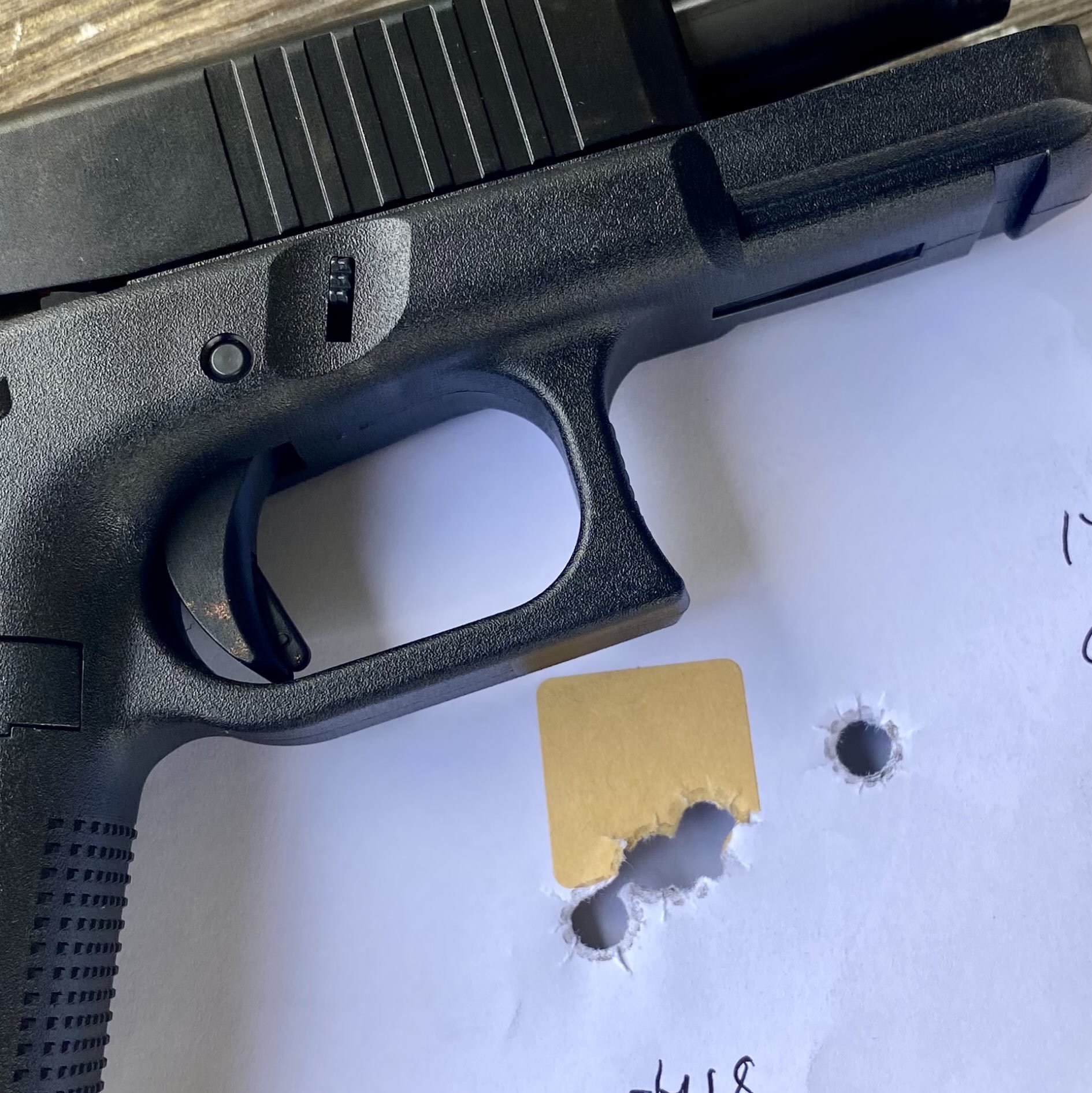
A 15-yard zero confirmation with the agency issued G45/COA with duty ammo (147-grain Gold Dot).
While shooting the same drill with a pistol optic, I simply place the dot in the middle of the circle, hold it there, and fire. My scores with the Humbler (aka the 700 Aggregate) have gone up on average about 25 points from around a 630 to scores consistently over 650. That’s a pretty solid score on a very difficult drill. One tip for shooting small targets more accurately at long range is to turn the dot’s intensity down. Make the dot as small as possible, as long as it is still visible. Just remember to turn it back up before you hit the street.
Backup Sights
An optic with co-witnessed irons gives you an instant redundancy. Most people will say that you need irons in case your optic fails…I contend that you also need an optic in case your irons fail. Yes, I’ve had iron sights fail. In the aforementioned Tom Givens class, my rear sight tried to walk its way out of the dovetail. I’ve also seen irons break and fall off guns (not necessarily my guns, but I’ve been around shooting long enough to see it happen).
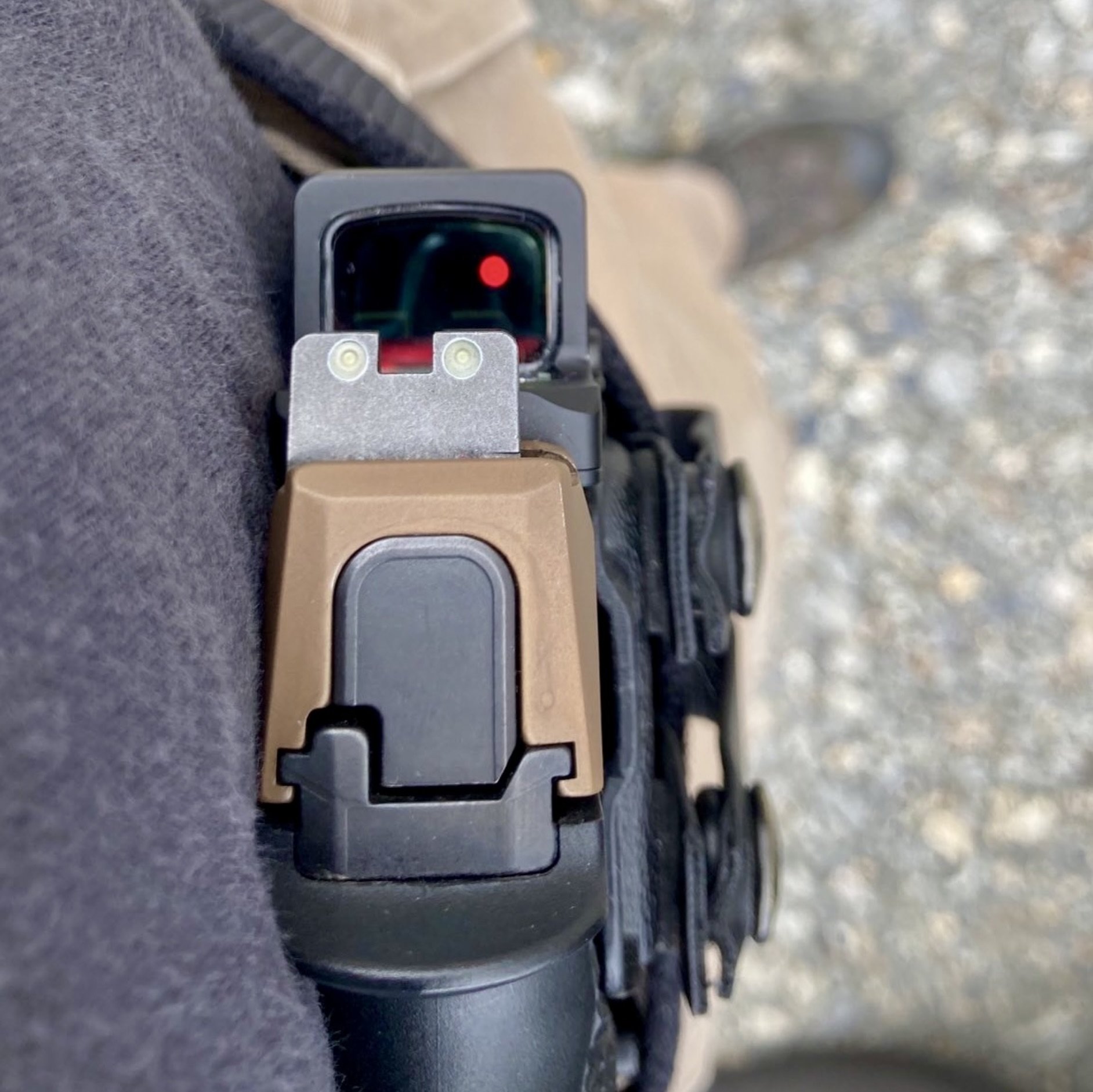
In one instance I was shooting a match with a close friend. After shooting the second or third stage, he went to the safe area. He removed his Glock 17 from the holster and confirmed that it now lacked a front sight. It happens. Two is one, one is none…something like that. Anyway, like it or not, the optic does provide a completely separate, and redundant sighting system, and that’s not a bad thing when it comes to fighting handguns.
Deteriorating Eyesight
Though I’m in phenomenal health for my age (just ran a Spartan sprint yesterday!), I’m only able to delay, not opt-out of the effects of aging. One of these effects is my eyesight. My eyes are still pretty good, but I’ve noticed an inability to do some things I was able to do with a handgun just a couple of years ago. I always placed a lot of emphasis on pinpoint accuracy at longer ranges. Unfortunately, in the past few years, I’ve noticed I just can’t quite do what I used to do with iron sights.
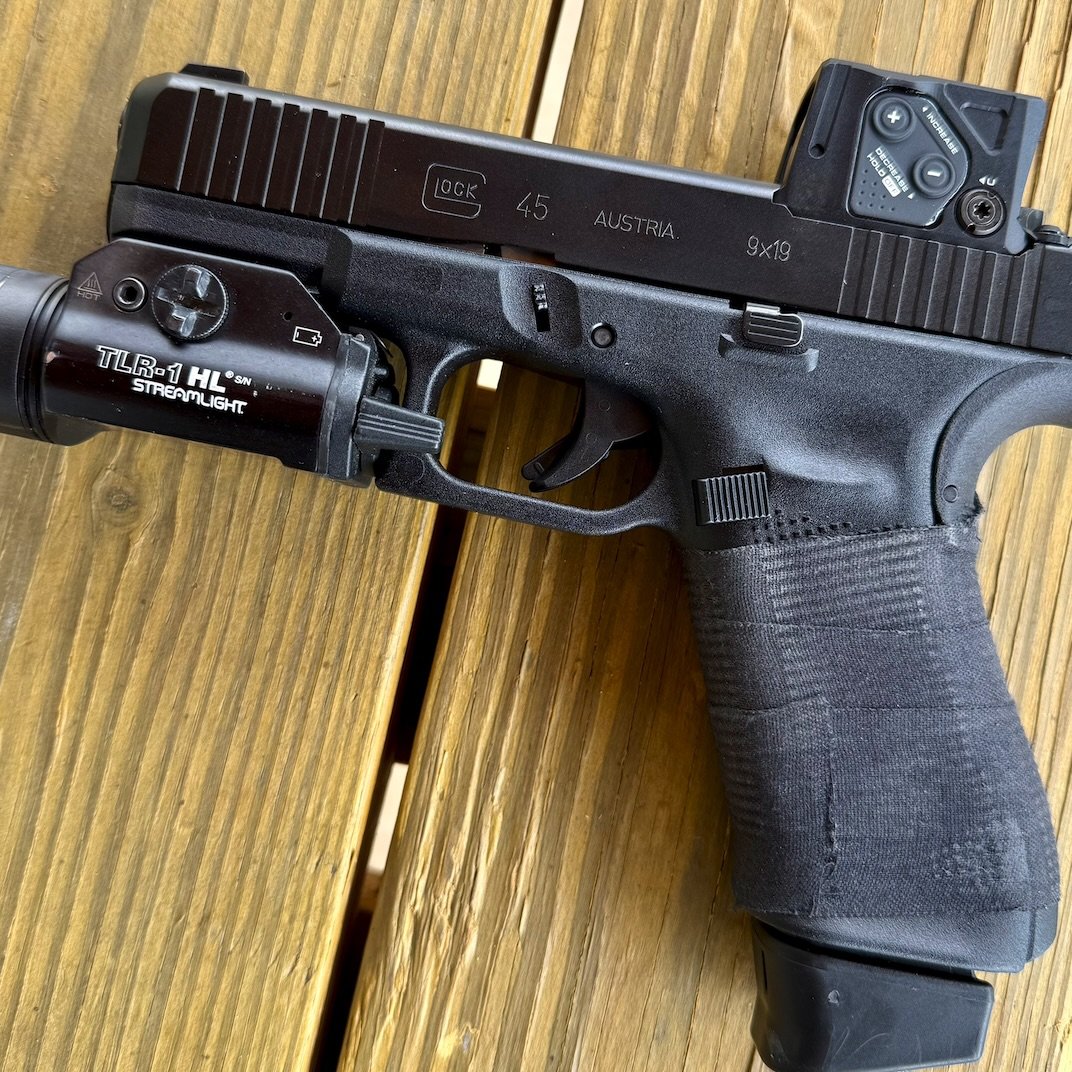
My agency-issued duty pistol. Dick Fairburn would call this a “tacticool” gun (skip to 4:17).
The optic really restored my confidence in my own accuracy. I can hit smaller targets, at longer distances, with greater accuracy than I ever could with iron sights. This is anecdotal to be sure, but again, I’ve yet to hear anyone who really mastered pistol optics revert back to iron sights.
Not only that, but optics will likely extend my shooting life. I plan to get a lot older than I am now. My eyesight, at this moment, is as good as it will be for the rest of my life…it’s all downhill from here. Optics will, in all likelihood, enable me to shoot with a high degree of accuracy for a long time to come. That’s important to me for not just defensive reasons, but for personal satisfaction reasons, as well. I like shooting and I want to be good at it as long as I possibly can.
Downsides of Optics
There are some downsides to optics. I would be remiss or lying if I didn’t acknowledge that. I think they are more than outweighed by the “pros” optics bring to the table, but that’s up to you to decide.
Expense: I didn’t think this was a big one until I really went wholeheartedly, all-in with optics. And then I wanted one on all my guns. Good optics are expensive, somewhere between $300 and $700 depending what you’re looking for. Having non-optic-ready guns cut for optics (a thing that is mostly going away) is expensive. Optics Planet or Palmetto State or someone usually has a sale going on, but optics are still expensive. This expense is exacerbated if you have to also buy a new holster to accommodate your optic-equipped pistol.
Bulk/Weight: I don’t think weight is a huge concern because even heavy optics only weight a couple of ounces. They are bulkier, though. They will be more difficult to conceal, all other things being equal. The smaller the optic is, the smaller the window will be, and obviously, the larger the optic window the harder the optic will be to conceal. An optic on a duty-sized pistol doesn’t seem like a huge deal, but it can have a dramatic effect on smaller pistols.
Optic Failure: I have yet to see an optic completely fail, but I have seen battery failures. I think backup irons and careful planning can mitigate this, however. I change my personal optic batteries out once a year (roughly one-fifth of their advertised lifespan). Likewise, our agency provides batteries for duty guns and changes them out at annual qualifications. Again, I have yet to see an optic fail, but like any manmade object (including iron sights), they certainly can.
Training: This is a false negative because all tools require training. If you throw a light on your gun, you should train with it. Your iron sights required a great deal of training to master. The downside to those old dogs already well-trained with iron sights is learning the proverbial “new trick.” Switching to a pistol-mounted optic isn’t a huge mystery - 10,000 repetitions will do it. Some, however, don’t want to make that time/effort investment.
Conclusion
Optics are a clear winner over iron sights in the infamous irons vs. optics debate. Optics are easier to use - just put the dot over the target. No multiple dots to line up or anything like that. Simple. Optics also provide a better visual field than irons. They don’t obscure the lower half of the target. You can still see important things like the bad guy’s hands. This benefit is enhanced exponentially by the fact that you can also actually focus on the target. It is possible to actually watch the bad guy and see if he drops the gun, keeps shooting, produces another weapon, or turns to run. These things might keep you out of prison.
At distance, optics provide better accuracy than iron sights. The also provide an instantly available redundancy in the event iron sights fail. I’m using that one sort of tongue-in-cheek; the irons are the backup, but the point remains, BOTH optics and irons can fail. Having a secondary sighting system on the gun is not a bad thing. And if you’re getting older (and who isn’t?) pistol-mounted optics can close a lot of that age-related vision gap.
Optics come with some downsides: cost, bulk and weight, the risk of optic failure, and a need for increased training time. Nothing is completely free of downsides, however, and these are small price to pay for the huge benefits. At least in my estimation.