The Hidden Benefit of Firearms Competition: An Anecdote
Most of you are probably familiar with the name Duane Liptak. I have never publicly mentioned knowing him, but he is central to this little story I'm about to tell. It's a story of competition, and being utterly and thoroughly humbled. It's also a story about the hidden benefit of firearms competition. Let's dive in.
This article contains affiliate links. Using these links gives us a small commission but costs you nothing. Please consider using our Amazon link to support this blog.
Origins and Disclaimer
The inspiration for this article was a recent episode of the Concealed Carry Podcast with Riley Bowman and Jacob Paulsen. The episode focuses on competition, with Riley (a USPSA GM) being "for", and Jacob being "against." This article will fundamentally be a disagreement with Jacob's position. However...
I want to issue a strong disclaimer right up front: even though I am going to disagree with Jacob, I have the utmost respect for him. He is highly intelligent and highly educated on the topic of concealed carry. He is a long-time concealed carry instructor and a serious student of the defensive handgun. My opinion does not mean that he is wrong - it's just my opinion and the result of my lived experience.
Regardless of my position on this particular issue, this is not a personal attack on Jacob. Also, this is really directed at Jacob, it was just a thought-provoking conversation, and I wanted to share my thoughts with you guys.
In any event, I strongly encourage you to listen to the Concealed Carry Podcast. It is insightful and accurate, and the episodes are enjoyable to listen to. It is one of my favorite firearms-related podcasts.
Now, here's a story for you guys about what I learned from my very first competition.
The Story
Way, way back in the single-digit 2000s, I was stationed at Camp Lejeune, North Carolina. I was a member of 2nd Marine Special Operations Battalion, now known as 2nd Marine Raider Battalion. Our company's air officer at the time was none other than Duane Liptak, the Executive VP of one of America's most prolific 2A brands.
Knowing I loved to shoot, Duane hit me up one Friday and said, "hey, there's a match tomorrow if you want to go." I said I'd attend, and went home that night and got my stuff ready. Forgetting that a huge percentage of Jacksonville's "civilian" population is former or retired Marines, I spent most of the 90-minute out to the range drive doing two things.
First, I imagined how I would mop the floor with these nasty civilians. Secondly, I silently disdained the racegun carrying "gamers" that were making a mockery of shooting sports, while patting myself on the back for being a serious student of the combative pistol. I pulled in, parked my high horse, and donned by sub-load (what we called a "battle belt" twenty years ago).
I'm sure I was strutting around like a bantam rooster when I walked up to the starting position to shoot my first stage. Again, keep in mind that I wasn't some rookie. I was a full-time gun-carrier with many weeks of some of the best pistol training anywhere, at least at the time. Under my belt were deployments to both Iraq and Afghanistan. I had extremely well-developed technical skill, incredibly good equipment, highly attuned situational awareness...
I didn't know what I didn't know. There is no way I could have predicted what happened next.
Shooter Ready?
I don't remember that stage exactly, but it was pretty simple. Start in this box and fire two at each silhouette. Run ten feet to this box, and knock down three pepper poppers. Run ten more feet to this box and finish with two on each of two silhouettes...or something like that. No target was more than 10 yards away. No crazy movements, no fault lines, no complicated stage plans, just a straightforward array of targets from three firing positions.
Standby! BEEEEEEP!!!
Off I went. I addressed the first two silhouettes.
BANG BANG! BANG BANG!
On to the next box. It's important to mention that I was shooting a full size, five-inch, .45 ACP 1911 at this time. My duty gun was a MEU(SOC) .45 so I carried a civilian analog made by Springfield Armory. I don't remember exactly, but I'm almost 100% certain I had a 10-round Wilson Combat magazine in the gun. Eleven rounds to do 11 rounds' worth of work. I arrive in the second box. Just knock down three poppers...
BANG BANG BANG DIIING! BANG BANG DIIING! BANG!
About this time I noticed my gun was at slide lock...and I STILL had a pepper popper standing. The silence was was deafening as I reloaded. I could feel every eyeball there drilling into my back.
Fortunately for me, going to slidelock was maybe the best thing that could have happened at that point. It gave me a chance to pull my head out of my ass and say to myself, "slow down and use your damn sights!" I finished off the stage. After holstering my gun I immediately placed my tail between my legs, and quietly tried to get through the rest of the match.
Duane didn't say a word to me about my performance that day - the mark of a real gentleman, in my opinion. He didn't know it, but he gave me a tremendous gift in inviting me to that competition.
The Hidden Benefit of Firearms Competition
For the rest of the day I remained absolutely flabbergasted. How could this happen to me? How could I do so poorly, when I had such outstanding technical ability? I didn't understand how two things - the fact of being a really good shooter, and the fact of my dismal performance - could simultaneously be true.
After a whole lot of self-reflection, I concluded that stress had played the biggest role in my miserable display. In the podcast that sparked this article, Jacob says that he has no interest in winning and therefore, wouldn't be stressed. I get the idea; I've never gone to a competition planning to invest serious effort in winning. Still, your brain will find a way to make some stress for you to work with. Here's mine:
When I step up to the firing position, there is an element rattling around in my head that goes something like this:
"alright, big boy, let's see what you've got. You say you don't care about competition? You're here for 'serious' reasons. You're only interested in defensive shooting and training for 'when it matters'? Ok, then! Show us sissy gamers what you've got. Show us how a tactical pro gets it done."
And that's the point, that's the hidden benefit of firearms competition. The most important thing competition can give you (at least in my opinion) is the opportunity to perform under stress.
The Hidden Benefit of Firearms Competition
Even if you don't care about winning, I promise that when you are the center of attention and everyone is watching you, you will experience stress. If you've never shot a competition, you should shoot one, just to see what that experience is like. You may shoot extremely well on the range when no on is watching - or even when students are watching - but it is a very different thing that being THE guy, shooting against everyone else.
Jim Cirillo had no reason to have any nerves whatsoever in competition. As a member of NYC's legendary Stakeout Squad, he'd won more gunfights than most of us can even really imagine... yet experienced stress in competition. He probably said it best, to Mas Ayoob: "Jesus Christ, I never felt this much pressure in any of my gunfights!"
You can go to classes, shoot on the flat range, and do the other things we do to train. Yet we get precious few opportunities to experience shooting under stress. Competition is one of the few venues that provides that. And even if you experience zero stress (you will, but let's just say you don't), you will still get to shoot in a completely novel venue with some added cognitive load. That's value in and of itself...but I digress.
So...What Does That Get Us?
A closer look at how we might shoot on our worst day. My "hits" sucked. I had a lot of C-zone hits in that match. I completely missed the poppers which, despite not looking much like a human, represent about the same area as looking at someone's side. That gave me a new appreciation for where I was actually at with the practical application of technical skills. It also taught me that if I'm in a civilian gunfight, it may not go exactly as expected.
This was an invaluable lesson for me, and it lead to another lesson: realizing what the problem was, I wanted to fix it. I didn't jump into the competition circuit, but I did start attending the occasional match. It's not the most fun thing for me (if you're only doing things you enjoy, how hard are you really training?) but I saw results pretty quickly. I learned how to harness my stress, Soon I was able to attend a match with very little stress at all.
The most important lesson-learned from that first match stage? I wasn't as good as I thought I was, and still had a long way to go. That pushed me to train - a LOT. I did two years of daily dry practice. I have spent thousands on classes and travel for classes. I read books and watch videos...not entirely, but at least partially because of that one stage.
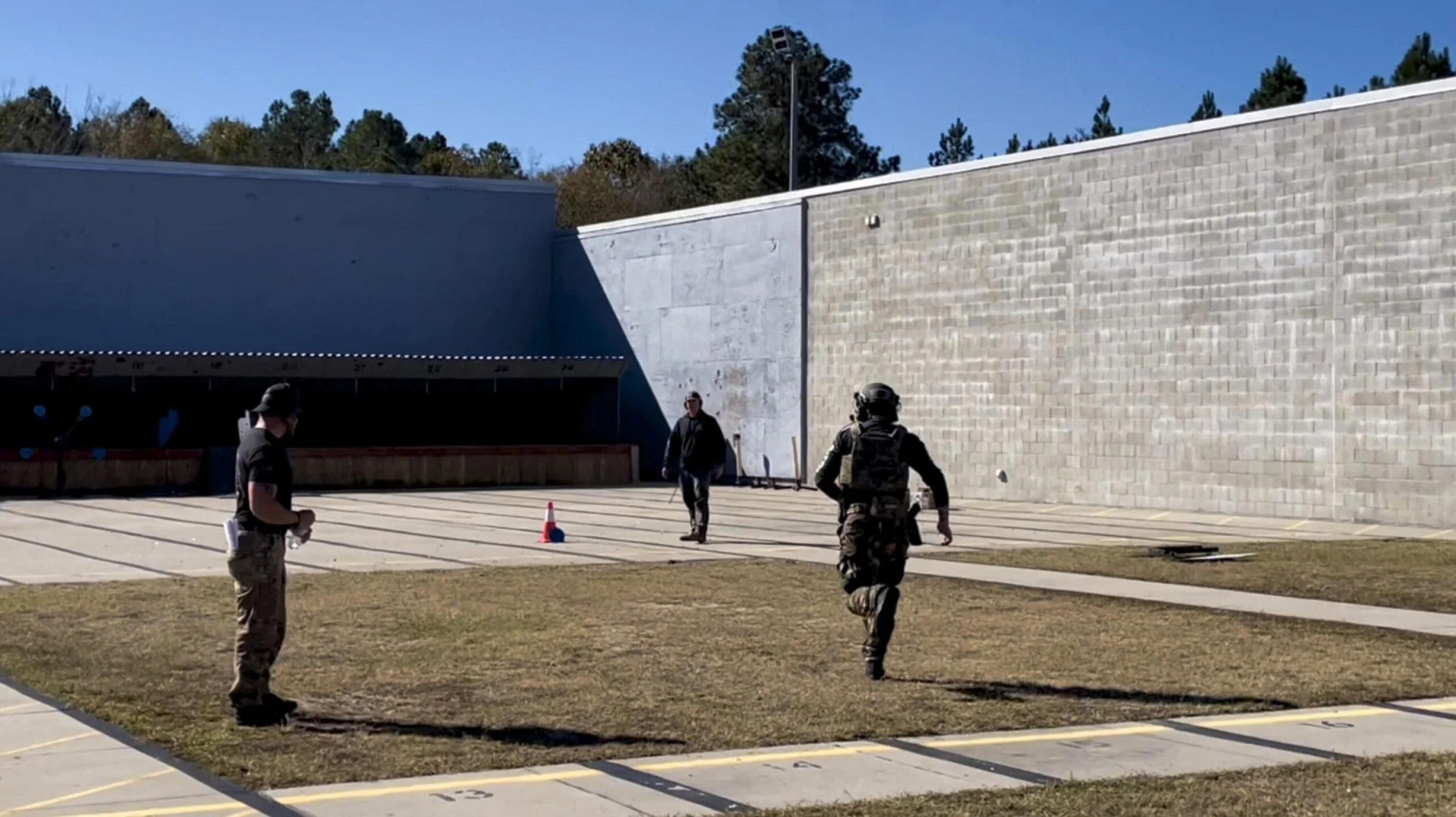
These days I don't compete often, but I do make a point of competing occasionally, just for the stress innoculation benefits. The featured photo on this article is yours truly at a state SWAT competition. A little different, but a lot the same.
Closing Thoughts
This was intended to be a short little story with a quick lesson-learned, so I better wrap up.
I do agree with Jacob on one thing: as I've alluded to, I don't enjoy competition. Shooting a big match is a huge time-suck, and most of your time is spent standing around. It's just not something I enjoy enough to do frequently. However, I usually find a match to attend every so often, just to get the value of shooting under stress. There are plenty of other benefits to competition in my mind...but those will have to wait for another time.
Again, a huge "thank you!" to Jacob for being a good sport! We recently recorded an episode that will be live soon. I'll post a link here when it's up. Stay tuned!