Terminal Ballistics II: What Pistol Bullets Do (And Don’t Do)
Today we’re going to take a look at what pistol bullets do…and don’t do. There is a lot of superstition around pistol bullets, around certain levels of power, and around certain calibers, bullet weights, and bullet designs. What pistol bullets do, though, is a fairly straightforward mechanical process. This article will examine that process. Maybe just as importantly, it will also attempt to dispel some myths and magical thinking about pistol bullets. If you haven’t read or watched the first part in this series, I strongly recommend doing so. Covering how pistol bullets actually “stop” bad guys, it lays a lot of groundwork for this article.
This article contains affiliate links. Using these links gives us a small commission but costs you nothing. Please consider using our Amazon link to support this blog.
If you'd like to listen/watch on Youtube, you can find this article here:
Bottom Line Up Front
Here are the useful takeaways from this article:
In a fight for your life, every single second (or fraction thereof) matters. It is critical that you end the attack as quickly as possible, because the longer the fight goes on, the greater the risk that you will be injured or killed.
To guarantee a timely stop, pistol bullets must strike a critical structure:
Brain or cervical spine (immediate)
Aorta, vena cava, heart (very fast)
Other large vessels, i.e. subclavian, carotid, femoral arteries (pretty fast…maybe)
Pistol bullets MUST reach one (or more) of these structures to force a stop.
As such, pistol bullets MUST be delivered with a high degree of accuracy, and
It often takes several pistol bullets to stop a bad guy, regardless of caliber, cartridge, bullet design, etc.
The Caliber Debate
I’m frequently intrigued by people saying some variation of “I see them soaking up 9mm and they just keep coming.” The flip side of this coin is something like, “I saw a video of a guy getting hit with one round of [insert pet cartridge] and going down instantly.” Unfortunately, no pistol bullet is a death ray, and I mentioned this in the last installment. Some of us hold onto thoughts like this, because - even though we all pay lip service to timers and switches - we don’t really understand the difference between the two. And when we see someone “set a timer,” we don’t actually like it.
We expect a pistol to be an immediate incapacitator, any time we shoot someone. That’s just not something handguns are capable of unless. you interrupt the central nervous system. If you’ll recall from the last article in this series, even if the heart is completely destroyed, the bad buy still has 10 to 15 seconds of voluntary activity.
A lot of what we expect pistol bullets to do is left to unquantifiable factors and magical thinking like “knockdown power.” We are trained - yes, even those of us who know better - by Hollywood to expect a certain result when someone gets shot. And sometimes you do get that result, either as the result of a CNS shot or more commonly, through a psychological stop. The truth isn’t very pretty, though. Hitting pretty much anything other than the central nervous system with a pistol bullet - any pistol bullet - simply cannot a guarantee an immediate, instantaneous stop.
I’m going to settle the caliber debate right now: if you compromise the heart, aorta, brain, or spine with a bullet, it doesn’t matter much which bullet it is - you will get a stop. Conversely, if you don’t hit the heart, aorta, brain, or spine, it doesn’t matter much which bullet it is - you’re in for a long wait, or the bad guy to decide he is done. No matter what caliber you use, you have to hit something that FORCES a stop, otherwise you are permitting the bad guy to choose to stop, or not. End of story. That said, none of the duty calibers are necessarily bad; .357s (Magnum and Sig),.40 S&W, 10mm Auto, and .45 ACP are all outstanding cartridges. However, they don’t do anything - at least in regards to stopping human attackers - appreciably better than 9mm. Even if you carry a magic caliber, you still have to hit something that matters.
"...there is no appreciable difference in the effectiveness of 9mm and the .45 ACP cartridges."
~ Dr. Vincent J.M. DiMaio, Chief Medical Examiner of Bexar County/San Antonio, TX, 40+ years of forensic pathology experience, author, Gunshot Wounds: Practical Aspects of Firearms, Ballistics, and Forensic Techniques (3rd Edition, 2021)
Today we will talk about the mechanical process pistol bullets use to achieve those first two: the CNS stop or a “timer” stop. But first, let’s talk about what pistol bullets don’t do. I expect this to be the controversial part of this article, so…have fun. And just so you know, I’m not ignoring you in the comments, I just don’t play in the comments.
What Pistol Bullets Don’t Do
Before we get into what pistol bullets do, we should probably talk about what they don’t do. Due to any number of intangible and unquantifiable factors, some gravitate to calibers with larger diameter, greater ft-lbs of muzzle energy, or greater perceived “stopping power.” A lot of this is based on a particular perception of a cartridge, along with a little bit of confirmation bias. I recently watched one YouTuber base his entire argument about a certain cartridge on one, single shooting video. Pistol bullets that fail to interrupt the central nervous system do not - cannot - force an immediate, instantaneous stop. Period.
How do I know this? Because sometimes even rifle bullets fail to stop determined human beings. Pistols are vastly inferior to rifles in the terminal ballistics and power departments, Yet sometimes, rifle rounds that fail to strike the heart, aorta, brain, or spine, fail to produce a stop. The history books and award citations are full of such cases, such as that of USAF Combat Controller Robert Gutierrez (his was the first result returned in a quick Google search, but is an outstanding example). Gutierrez was shot through the chest in Afghanistan in 2008. The bullet broke ribs, punctured his lung (which later collapsed), took a huge chunk out of his back, yet continued to fight…for four hours. Gutierrez received an Air Force Cross for his actions.
If a rifle bullet to the chest didn’t produce an instantaneous stop, do we really expect ANY pistol bullet to reliably produce instant stops?
The .357 Sig, 10mm Auto, and .45 ACP made some amazing, instantaneous, one-shot stops. And for that matter, so have the 9mm, .32 ACP, .22 Long Rifle, .380 ACP, .25 Auto… But regardless of the caliber, it’s for one of two reasons: the bad guy chose to give up, or it hit something really important. What is beyond question is that these stops are absolutely NOT because of hydrostatic shock or stopping power or energy dump.
Below are a look at things pistol bullet’s don’t do. This is essentially a glossary of meaningless terms.
Pistols Don’t “Stopping Power”
Pistol bullets don’t produce “knockdown power,” “slap effect,” or any other quantifiable metrics allowing us to assign a numerical value to how readily a bullet will stop a bad guy. There have been various attempts to quantify the amount of power a given bullet has. There are simple measures of energy, usually stated in ft-lbs, as we commonly see on boxes of ammo. I don’t think this is terribly meaningful information. There are scales like the Justice Department’s Relative Incapacitation Index (full DOJ PDF available here) that tried to score handgun bullet effectiveness relative to where it hit on the body. Then there’s the old Taylor Knockout Factor that attempts to lend more gravitas to bullet diameter and weight than to velocity (though in fairness, the TKOF was really intended for hunting cartridges). And of course, there were the “one-shot stops percentages” calculated in books like Handgun Stopping Power (I had a copy when I was younger and spent many, many hours poring through these charts).
The fact is, handgun stopping power is much more a result of where you hit the bad guy than what you hit him with. If we don’t hit something vital, we leave the decision to the bad guy to stop or not. The larger .45 bullet might be more convincing, but as we’ve see in case studies, it is far from a guarantee and we shouldn’t depend on that. If we make a good hit, to the heart/aorta, for instance, the bad guy will lose soon consciousness and the fight will end. Alternatively, if we compromise the brain or spine, the fight will be over instantaneously.
Bottom line: If you destroy the heart, aorta, brain, or spine, it doesn’t matter all that much what you do it with. If you don’t hit one of these targets, it doesn’t matter all that much what you do it with. Even if a particular caliber/cartridge combination is a 99% one-shot-stopper, sometimes it will fail and we cannot depend on marginal hits.
Pistols Don’t “Stretch Cavity”
In synthetic gelatin testing there is a phenomenon known as “temporary wound cavity” or stretch cavity. This is the large stretching effect that happens when the bullet impacts the gel. Very frequently, in the YouTube environment, this temporary cavity is shown slow motion. In still photographs, dye is often inserted into the gel to highlight this cavity. But there are a few things wrong with this, at least as the conversation pertains to pistols.
First, this cavity is only temporary. When a pistol bullet strikes tissue, the tissue reacts, but most tissue in the body including skin, muscle, and lungs is very elastic. You can probably push your finger into your own abdomen and create a temporary cavity that will immediately spring back when you remove your finger. The same thing happens to human tissue (which is different from ballistic gelatin) when a handgun bullet passes through.
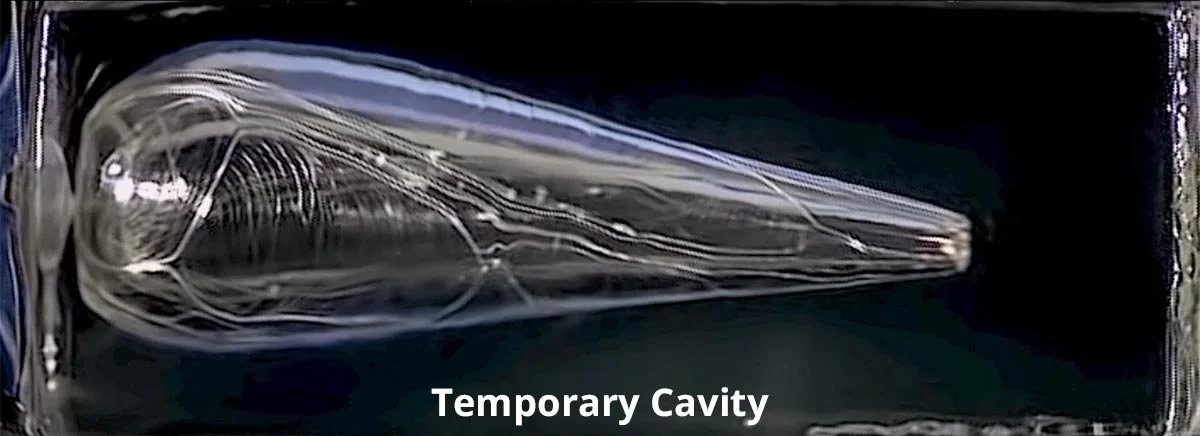
Image retrieved from https://www.luckygunner.com/lounge/why-ballistics-gel-works/
There is some truth to this idea, however. Rifle bullets moving at a very high velocity can cause permanent wounding in this stretch cavity. Because they are moving so fast, the can cause body tissue to exceed its elastic limits. This causes secondary wounding, or wounds to tissue that the bullet does not actually strike. The generally accepted velocity at which this begins to occur is 2,000 feet per second. I sometimes hear this called “the magic velocity,” but this phenomenon is not a binary. Just barely limping over the threshold of 2,000 FPS will only begin to cause secondary wounding. In other words, there is a big difference between a 5.7×28 bullet moving at 2,050 FPS and a 5.56 moving at 3,250 FPS. In fact, Dr. DiMaio mentions a second velocity threshold (2,625 - 2,950) at which secondary wounding is substantially increased.
It’s important to remember that while ballistic gelatin is meant to simulate human tissue, it is not actually human tissue. It behaves differently. While tearing of gelatin at pistol velocities does occur, this does not perfectly translate to what happens in human tissue.
Pistols Don’t “Energy Dump”
One of the big buzzwords, as it pertains to handgun ballistics is “energy dump.” Energy is a combination of the bullet’s mass (weight) and the velocity (speed) at which it is pushed. Pistol bullets do carry energy, and they do expend that energy. The use for that energy is relatively straightforward, though: that energy is used to drive the bullet (which, ideally is expanding), to its terminal depth. This energy is used to conquer intervening obstacles including air resistance as the bullet travels to the target, then penetrating through skin, muscle, bone, etc. And that is all. Any other energy that is “transferred” or “dumped” simply stretches tissue, usually within its elastic limits.
Here are some more common myths that kind of fall under the category:
A bigger hole promotes blood loss. You can bleed completely out in seconds without a hole in your body at all. In one case of an ruptured aortic aneurysm that I worked, a woman died in a matter of seconds my ambulance with no new lumens to the outside world. Likewise, Trooper Coates (whose case study was examined in the last article) died in seconds from a .22 bullet to the aorta. Meanwhile, his attacker survived five .357 Magnum rounds to the chest. A tiny, underpowered bullet to the right location means more than a big, powerful bullet every where but the right location.
A bigger hole “lets air in.” Pulmonary compromise will kill someone. Poking holes in the lungs can cause tension pneumo- (and hemo) thorax, a terminal condition if not treated. A tension pneumothorax takes time develop, however. The scale of time is irrelevant to ending fights quickly unless we are in really, really prolonged gunfights. We need the fight to be over in a matter of seconds, not minutes.
We need more “damage” to tissue. Though this may contribute to the psychological stop, what we actually need is precise damage to the heart, great vessels, brain, or spine. A hole through the aorta, heart, brain, or spine is definitive. Any additional “damage” produced - from hollowpoints, external hollowpoints, fragmenting bullets, or any other pistol bullet - is largely irrelevant for anything other than a psychological stop.
Even if we believe that .45 “puts ‘em down,” we know beyond a shadow of a doubt that sometimes it doesn’t. Maybe it “puts ‘em down” better than 9mm? But we also know this is not a guarantee. We’ve see the case studies. Gabriel Tauscher was shot fifteen times in the arms, legs, and torso with a .45, and was still able to draw his gun and end the fight. Jared Reston took seven rounds of .45, including one to the face and it didn’t “put him down.” Reston also put 14 rounds of .40 S&W into his attacker, but it was only the last three of those - in in the head, that finally stopped him. Timothy Gramins put 14 rounds of .45 in his adversary and he “just kept coming” until he was turned off with a brain shot. And Trooper Mark Coates put five rounds of .357 Magnum hollowpoints (not .45, but unarguably more powerful than 9mm) in his adversary’s chest, to no avail; the bad guy still killed Coates with a .22 and lived another three decades.
Why are we still debating power and energy and bullet size and weight and how to better hit the heart, aorta, brain, or spine?
What Pistol Bullets Do
Pistol bullets perform a mechanical function. When fired, energy is imparted to the bullet via the chemical reaction of the propellant converting quickly to a large volume of gas. Some of this energy is consumed as the bullet moves toward its target. More energy is consumed as it penetrates, crushing or pushing aside tissue along its path, before coming to rest. Tissue directly in the path of the bullet is destroyed. And that is all. In the words of Clint Smith, “pistol bullets put holes in people.” It’s really as simple as that. To borrow another analogy, this one from Chuck Haggard, imagine poking a dowel rod through a human body. Whatever it hits on its way through will be damaged. Whatever is not touched by the dowel rod is not damaged.
If the bullet strikes something important - the heart, aorta, brain, or spine - it can provoke an “enforced” stop, either from bleeding out or from an interruption of the central nervous system. If it hits anything else, we are left to hoping that it provokes a psychological stop. This is also known as the bad guy choosing to stop. If pistol bullets strike the brain or spine and interrupt the central nervous system, the bad guy will be immediately and irrevocably incapacitated. He will go down instantaneously and the fight will be over. If pistol bullets strike the heart or aorta - or a combination of other large vessels - the bad guy will lose blood and soon lose consciousness. Be aware, he may still be a very active threat in the meantime.
Pistol bullets are not magic. Handgun rounds striking pretty much anything else are survivable, at least for the duration of a gunfight. Let’s take a look at what we actually need a pistol bullet to do to achieve a physiological stop, either “setting a timer” or “flipping a switch.”
What We Need from a Pistol Bullet
With this idea in mind - that we must hit the heart, aorta, brain, or spine to guarantee a stop and that caliber is irrelevant - you may be wondering why we don’t use some very small caliber. The .22 LR, for instance, would allow us to stack dozens of cartridges in a magazine and have almost no recoil. There are a few things we need from a pistol bullet, that push us to the “duty calibers.”
Acceptable Reliability & Accuracy
Amid the all minutiae (and this really is minutiae we’re discussing), it’s easy to forget that we need a cartridge that will function in our gun, and hit where we aim. These criteria are less ammunition factors, and more a factor of the unique combination of one particular gun and one particular load. Fortunately, if you stick with a reputable, mainstream firearm, and a reputable, high-quality, conventional cartridge design, your chances of finding a reliable, accurate combination are very high.
Above all else, our chosen ammunition must be reliable in our handguns. I would readily choose a reliable full metal jacket load over an unreliable hollowpoint load. Modern ammunition is incredibly reliable. It should be proven reliable in YOUR gun, however. Since hollowpoint ammunition is expensive, I would first prove that the gun is reliable. I don’t think it’s a big ask to put 1,000, malfunction-free rounds through a modern duty/carry pistol before declaring it reliable. After that, I would put at least 50 rounds of your preferred hollowpoint ammo through it before trusting my life with it.
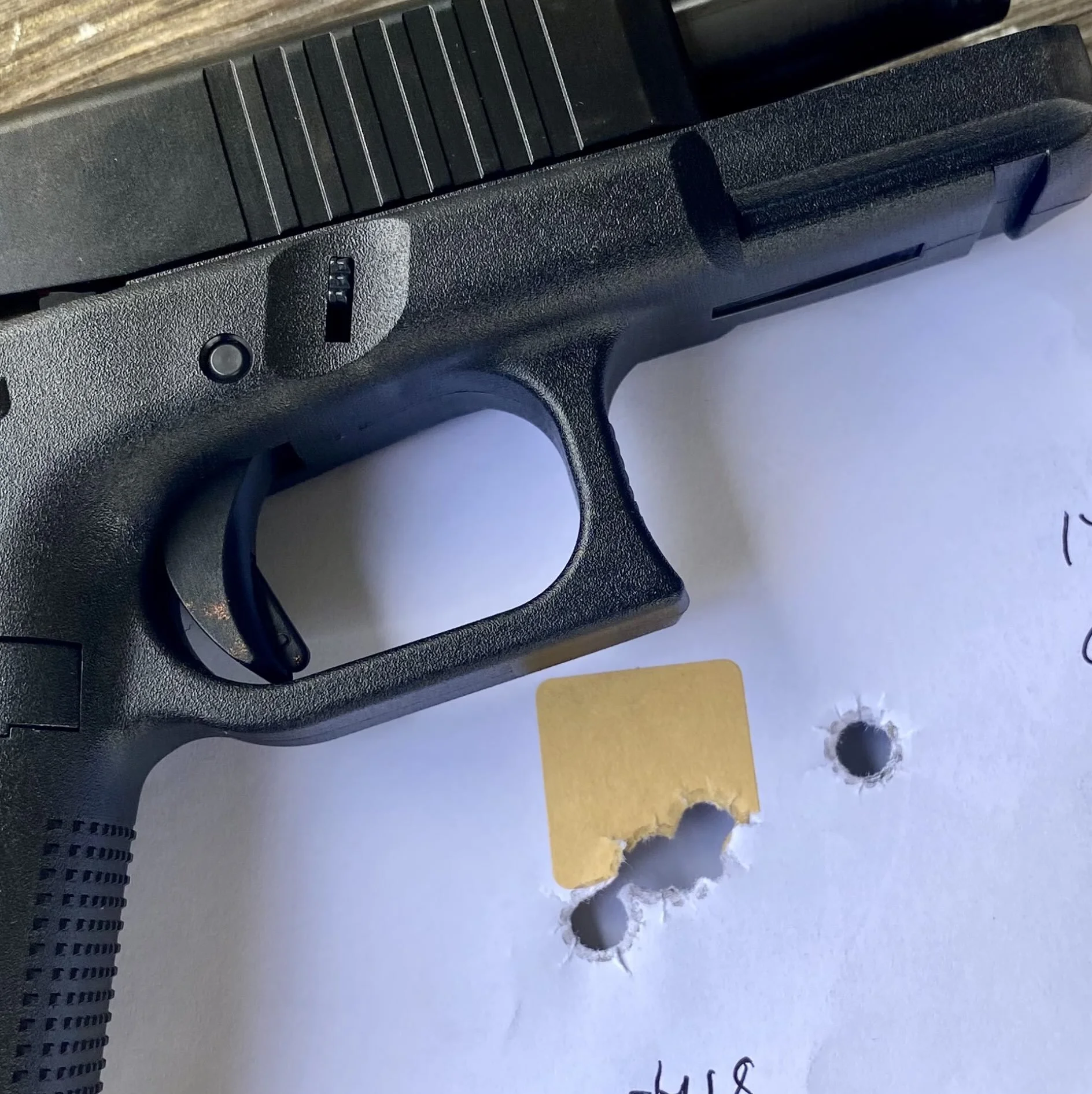
A 15-yard, offhand group with my duty gun and duty ammunition. This is acceptable accuracy.
While firing those 50 rounds, I would make sure to zero my optic precisely to that ammunition at the yard line of your choice. I happen to like a 25-yard zero, based on Aaron Cowan’s recommendation and my own subsequent experience. If you disagree, it’s just what I do, not a recommendation. The one place you may have to try several loads to find one that hits to your sights is with a fixed-sighted revolver. Revolvers - especially .357 Magnum revolvers - may have sights regulated to a certain bullet weight and velocity. The benefit of being able to shoot a wide variety of ammo also comes with a downside. Shooting .38s out of the gun may find you printing significantly low, or shooting lighter, faster .357s might find you shooting quite a bit high. This can happen with semi-autos, but the velocity ranges aren’t as large, and most pistols with most factory ammo hit pretty much point-of-aim, point-of-impact.
Accuracy is extremely important, as we’ll see in Part III of this series on tactical anatomy. After reliability and accuracy, we need the following:
Sufficient Penetration
"The primary ammo criteria for [caliber] is ensuring functional reliability, followed by adequate accuracy, then reliable penetration beyond 12 inches."
~ Dr. Gary K. Roberts
First, we need sufficient penetration to strike vital organs (heart, great vessels, brain, spine). This means the bullet must have enough energy (a combination of mass and velocity) to get deep into tissue. Authoritative sources like Dr. Martin Fackler and the FBI’s ballistic research facility have determined that if a bullet penetrates 12 to 18 inches in 10% calibrated ordinance gelatin, it will penetrate deeply enough into a human body to strike these vital organs. Penetration to an adequate depth is so important that the FBI weights it at 70% of their scoring criteria.
Keep in mind that penetration in ballistic gelatin is not a 1:1 ratio to penetration in human tissue! One inch of penetration in gel DOES NOT equal one inch of penetration in a human body; ballistic gelatin and a live human body are not the same and are not intended to be. For example, human skin is far tougher than ballistic gelatin. It is estimated that getting through the first three to four inches of ballistic gelatin is roughly equivalent to getting through human skin. The point: it is not a one-to-one ratio. This is where YouTube has failed us so spectacularly with things like synthetic gel heads and torsos; though entertaining to watch, they tell us less than nothing about how bullets will perform on live humans. I say “less than nothing” because some percentage of the population will make bad ammunition choices based on these videos.
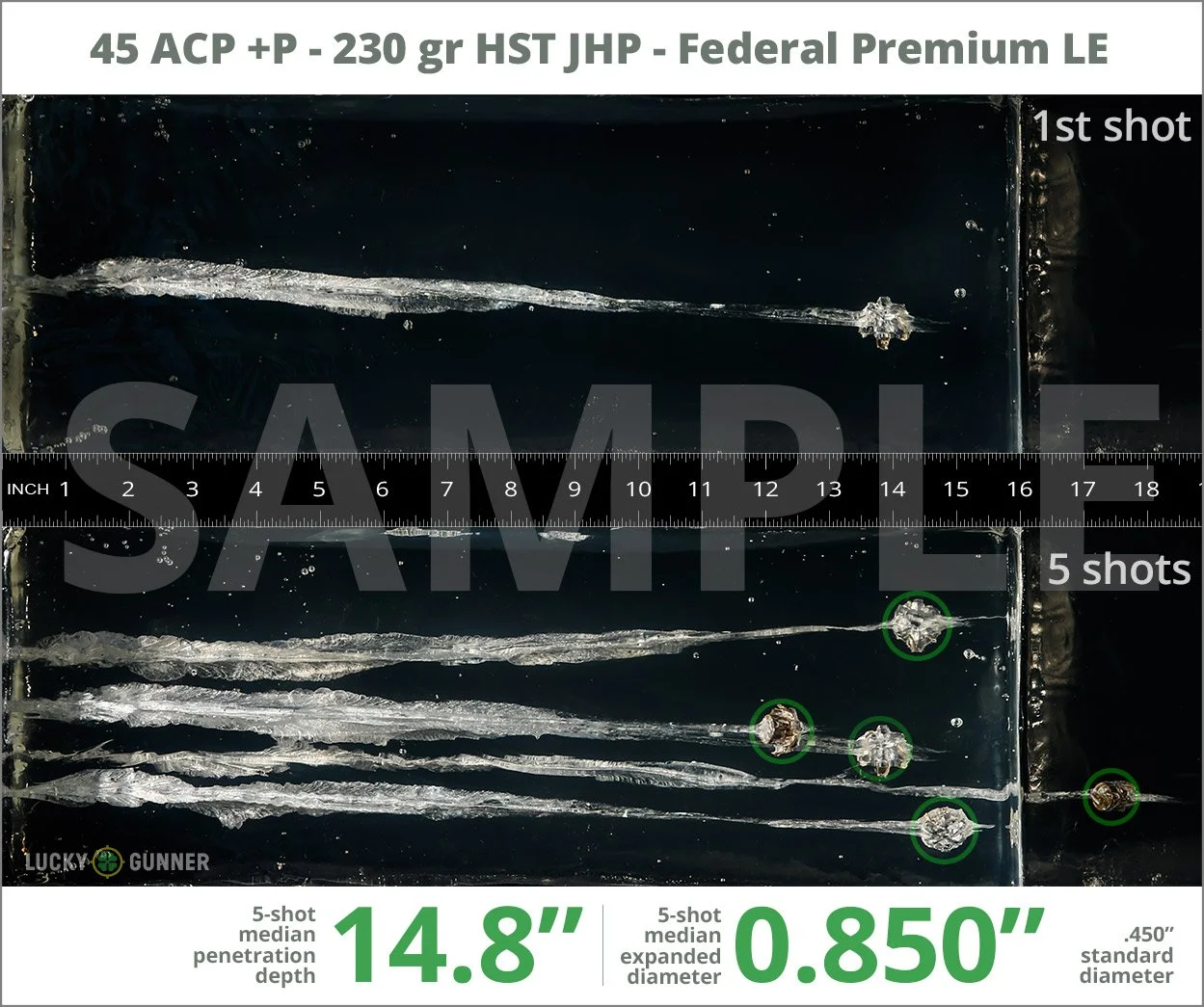
Image retrieved from https://www.luckygunner.com/labs/self-defense-ammo-ballistic-tests/
Also keep in mind that a bad guy is not likely to present to us like a B27 silhouette, stationary and presenting a full frontal. Some are now saying that “civilians” don’t need to worry about 12 inches of penetration because we aren’t approaching people on vehicle stops where we would be presented with a profile shot. Keep in mind, though, one you start shooting someone he is unlikely to stand still. And if he is presenting a pistol or other weapon, you may have to shoot through arm to get to the upper chest cavity. Also keep in mind, not all humans have an “average” chest thickness; there are some heavily-muscled bad guys, and some very fat bad guys. To force a stop your bullet must be able to defeat muscle and fat (and sometimes an intervening arm) and get to the aorta or heart.
We also need sufficient energy to resist deflection. The body is full of a variety of tissues and textures. There is skin, muscle, fascia, bone, solid organs, and hollow organs. There are liquid-filled cavities and air-filled cavities. We need the bullet to penetrate through any combination of this, in roughly a straight line, to the heart, aorta, brain, or spine, with enough energy remaining to compromise those structures. This is the main reason the very small calibers aren’t ideal; under perfect (or worst-case, depending) they can penetrate deeply, but don’t do so quite as reliably as the “duty” calibers.
Sufficient Expansion
Expansion is a distant second consideration to penetration. Unfortunately, it is by far, the most overemphasized factor in assessing handgun bullets. Most YouTube videos show a quick shot of the penetration of the bullet, the the thing everyone is waiting for are the sexy shots of mushroomed bullets. But really, why do we care about this at all? A completely non-expanded bullet that punches a hole in the aorta, heart, brain, or spine, is going to end the fight. Keep this in mind; frankly, I don’t care all that much about expansion at all, relative to penetration; if the bullet doesn’t get to where it needs to go, expansion DOES NOT MATTER. All that extra damage is to stuff that isn’t going to bleed substantially enough to make a huge difference to a determined attacker.
So why do we need expansion? First, it acts as a parachute. To have a bullet with enough mass and velocity to reliably penetrate through skin, muscle, and bone to the heart, aorta, brain, or spine, we also have enough mass and velocity to overpenetrate. Many think that overpenetration is a myth, but Massad Ayoob, if you place any stock in him, contends it’s a very real danger. In an article aptly titled, “The Very Real Danger of Over-Penetrating Bullets” Mas details some cases where folks were hit with bullets that had passed through others. This includes the 2024 case of an armed Citizen shooting a bad guy. His bullet went through the bad guy’s head, killing him. It continued on and struck a bystander in the head, killing him, too.
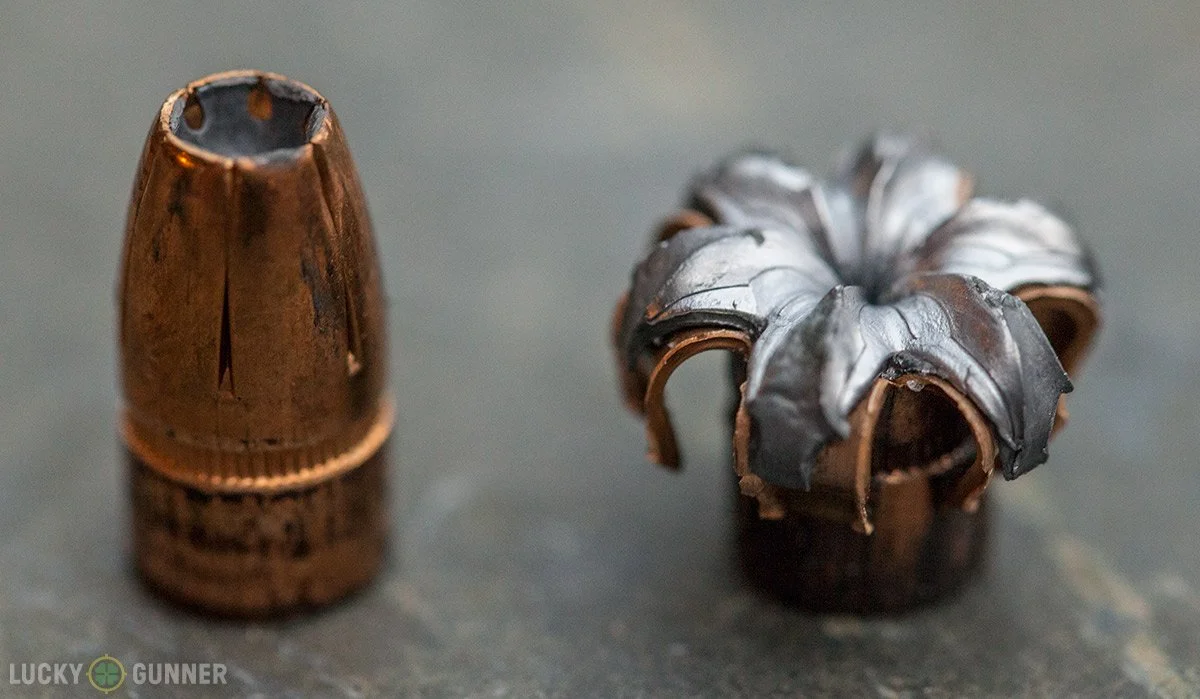
Unfired and expanded JHP bullets. Image retrieved from https://www.luckygunner.com/labs/self-defense-ammo-ballistic-tests/
The other raison d’être for penetration is to actually crush tissue instead of just pushing it aside. Rounded, smooth bullets of the full-metal jacket persuasion can push aside critical structures rather than “biting into” them. A bullet that expands creates a sharper, wider frontal area that cuts and tears through tissue. Creating damage for the sake of damage is not the goal, but if the bullet does strike a critical structure (heart, aorta, brain, or spine), we want it to compromise it.
The reason for expansion is not so we can “hit ‘em over here and damage something over there.” This is a pretty common myth; the bigger bullet means a greater likelihood of hitting something important. But there are only a few truly important things: the heart, aorta, vena cava, brain, and spine. You have to already be really, really close to one of these things for an increase of a couple tenths of an inch to make a difference.
My Ammunition Recommendations
Fortunately, it’s not a mystery what ammunition to use. And we don’t have to choose one criteria - i.e., an under-penetrating bullet in the interest of expansion or something - because the top-tier bullets do the job really well. In my opinion, the best possible ammunition out there are the following three. They will all penetrate deeply enough to get the job done, all expand as reliably as any bullet out there. They are made from premium components and - especially relative to cheap ball ammo - are far more likely to be properly loaded, waterproofed, etc.
For the most part, the +P designation is unimportant. Though it adds a bit of velocity, the bullets listed below are of a mature enough design that they will both penetrate and expand within their intended velocity envelope. I do have some defensive ammunition that is +P, and some that is not, and it is unlikely that the difference will make a difference.
In alphabetical order, I’d happily use any of the following bullets:
Federal HST: Federal’s flagship duty/defensive load is a top contender. Three 9mm loadings of the HST are available: 124-grain, 124-grain +P, and a 147-grain. All of these are perfectly adequate for concealed carry or duty use.
Hornady Critical Duty: The FBI chose a Hornady round as its duty ammunition. Note that Critical Duty and Critical Defense look a lot alike but are not exactly the same thing. The Critical Duty bullets are slightly tougher and penetrate a bit more deeply. This bullet comes in 124-grain +P, 135-grain, and 135-grain +P loadings.
Speer Gold Dot: The Speer Gold Dot is the grand daddy of defensive ammunition, still being as relevant today as it was when released in 1991. Several bullet weights are available including 115-grain, 124-grain, 135-grain, and 147 grain, mostly in +P and standard pressure loadings. Personally, I would stick with the 124- and heavier bullets. I carry 147-grain Gold Dots in my duty handgun.
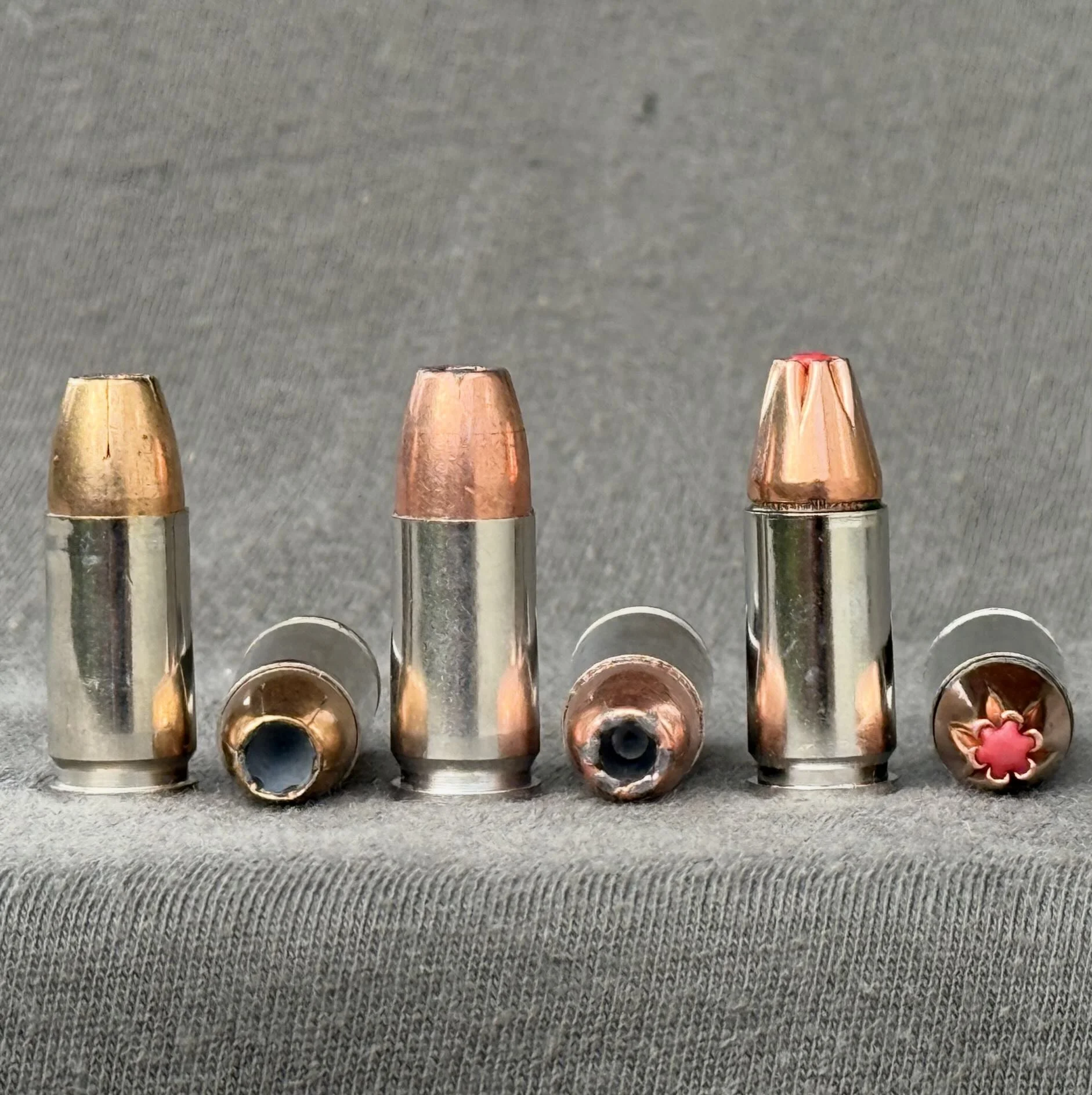
L - R: Federal 124-gr +P HST, 147-grain Gold Dot, 135-grain +P Critical Duty.
In my opinion, if you’re not using one of these bullets I think you should have a pretty compelling reason why. These are the most exhaustively tested handgun bullets in the world. They are widely available. They have impressive track records (the Gold Dot’s street record goes all the way back to 1991). These three bullets are trusted by thousands of law enforcement agencies in the United States and internationally.
That’s not to say there aren’t reasons for using them. In the low-to-middling calibers like .32 ACP and .380, penetration is always a concern. These bullets may not have enough power to both penetrate and expand. In that case, I don’t mind running FMJ in the slightest. I always run FMJ in my Kel-Tec P-32. Though I’ve played with running the 99-grain HSTs in my Bodyguard 2.0, I usually carry it on duty with FMJ ammo because if that gun comes out, it needs to get bullets to the heart, aorta, brain, or spine. Another possible reason is running wadcutters in a revolver. The have low recoil, tend to cut a decent, caliber-sized hole.
The Take-Aways
Again, this was a very long article. We can distill this down to a few statements, though.
First, handgun bullets don’t do anything magical. They don’t produce stopping power or knockdown power. Handgun bullets don’t generate hydrostatic shock, a stretch cavity, and a temporary cavity is just that - temporary. The don’t really need some high-speed, low-drag bullet to “do more damage” and we don’t need a bigger hole to “let air in.” In an ideal scenario they penetrate, wound whatever is in their pathway before coming to rest. That’s all they do.
What we need is to strike the heart, the great vessels, the brain, or the spine. The heart and great vessels will initiate a timer stop, though it may take as many as fifteen seconds for this stop to fully be achieved. To do so, the bullet must penetrate deeply enough to reach these structures, with enough energy remaining to compromise them. At the same time, we need them to expand enough to avoid over-penetrating - that is, leaving the target with enough energy to be lethal on the far side.
And that’s about it. Choose a good, high-quality hollowpoint like the Federal HST, the Hornady Critical Duty, or the Speer Gold Dot. If it is reliable in your gun, and acceptably accurate, you will meet all these criteria. It really doesn’t matter what caliber you choose; if you strike the heart or aorta you will set a very fast timer. If you strike the brain or cervical spine you will cause an instantaneous stop.
And that’s pretty much it!